Trading confluences explained: how to combine liquidity, fair value gaps and market structure into one high-probability system
You can order the same kind of articles for your own video to boost it on YouTube and Google. Just message the Telegram bot @sat_sit_bot. It writes articles around your video, embeds the video and publishes them on popular niche websites (no ads). Your first 50 articles are free.
· based on the channel TJR
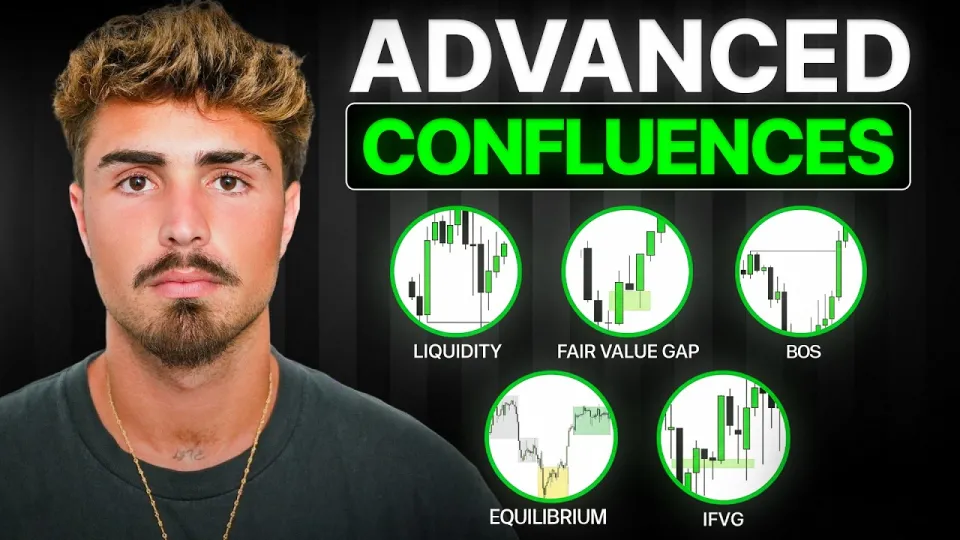
Trading confluences are independent technical signals that align on the same price area, timeframe and direction, and stacking at least three of them is what separates a random entry from a high-probability setup. TJR's video "Learn Every Trading Confluence In 18 Minutes" walks through the main building blocks — liquidity, fair value gaps, inverse fair value gaps, equal highs and lows, and break of structure — and shows how they fit together. If you want the full framework behind these concepts, TJR offers a free blueprint at the full-time trader blueprint.
What a trading confluence actually is and why one signal is never enough
A trading confluence is any factor that increases the probability of a setup working, and the key is knowing which confluences actually add value to your strategy rather than collecting indicators for the sake of it. Price action confluences include a liquidity sweep, a fair value gap, an order block, a break of structure, equal highs or lows, and a higher-timeframe level such as a daily or weekly high. Each one tells you something different: liquidity shows where stops are resting, a fair value gap shows an imbalance that price often revisits, and break of structure shows that control has shifted between buyers and sellers. When two or three of these line up at the same price, the probability of a reaction rises — not because the signals are magic, but because they describe the same underlying order flow from different angles.
The five confluences TJR breaks down in 18 minutes
TJR structures the video around five core concepts that traders can mark on any chart, and each one answers a different question about where price is likely to go next.
- Liquidity — clusters of stop-loss orders above equal highs or below equal lows. Price is often drawn to these pools before making a real move, so a sweep of liquidity followed by a reversal is one of the strongest single confluences.
- Fair value gap (FVG) — a three-candle imbalance where the wicks of the first and third candle do not overlap. Price frequently returns to fill part of that gap before continuing, which makes it a useful entry zone.
- Inverse fair value gap (IFVG) — a fair value gap that fails to hold and gets traded through. Once price closes beyond it, the same zone can act as support or resistance in the opposite direction.
- Equal highs and equal lows — two or more swing points at nearly the same price. They signal resting liquidity and often precede a stop run before a reversal.
- Break of structure (BOS) — a close beyond a prior swing high or low that confirms a shift in market direction. BOS is the confirmation layer: it tells you the context has changed, not just that a level was touched.
The power comes from combining them. A liquidity sweep into a fair value gap, followed by a break of structure in the opposite direction, is a classic high-probability sequence that appears across forex, indices and crypto charts.
How to stack confluences into a repeatable trading checklist
Stacking confluences works best as a fixed checklist that you run before every trade, because decisions made in the heat of the moment are usually the ones that break the rules. A practical sequence looks like this: first mark the higher-timeframe structure and the nearest liquidity pools; then wait for price to sweep that liquidity; then check whether the sweep landed in a fair value gap or at an inverse fair value gap; finally require a break of structure on a lower timeframe before entering. If any of those boxes is empty, the trade is a pass. This approach filters out most low-quality setups and makes journaling far more useful, because you can tag each trade by which confluences were present and see which combinations actually pay you.
Common mistakes traders make with confluences
More confluences do not automatically mean a better trade, and the most common mistake is forcing five or six signals onto a chart that only supports two. Another frequent error is marking fair value gaps on every timeframe and treating them all as equally important — in practice, a gap on the higher timeframe carries far more weight than one on a one-minute chart. Traders also tend to ignore the sweep and enter on the gap alone, which means they are buying into the liquidity rather than after it has been taken. Finally, many treat break of structure as an entry signal when it is really a confirmation of context; entering on the break itself often means chasing price at the worst part of the move.
What the audience asks most about trading confluences
The questions that come up most often around this topic are about how many confluences are enough, how to practise without losing money, and how to stay disciplined when social media shows only the winning side. A common theme in trader discussions is that you will lose money at the start no matter what, and that the traders who last are the ones who keep showing up, keep a journal and treat each loss as data rather than a verdict on their ability. Another recurring point is that social media is designed to trap beginners with highlight reels, so comparing your equity curve to someone else's screenshots is a fast route to breaking your own rules. The practical answer is to backtest and forward-test a small number of confluence combinations, record the results, and only increase risk once the data — not the dopamine — says the edge is real.
Useful resources
- The exact system to becoming a full-time profitable trader
- Indicators TJR uses daily
- Funded account raffle entry
- Alpha Futures funded accounts — 10% off
- Lucid Trading — 40% off
- Tradeify funded accounts — 30% off
- TradeZella trading journal
- HeroFX broker
Final thoughts
Trading confluences are not a secret indicator but a way of thinking: each signal answers a different question, and the edge appears when several answers agree. TJR's 18-minute breakdown is a compact map of the five concepts worth mastering first — liquidity, fair value gaps, inverse fair value gaps, equal highs and lows, and break of structure — and the channel is a solid starting point for traders who want structure rather than noise. The work that follows is yours: build a checklist, backtest it, journal every trade and let the data tell you which confluences actually pay. If you want TJR's full system, start with the free trader blueprint and treat every other resource as a supplement, not a shortcut.
Key takeaways
- Confluence in trading means stacking independent signals that point to the same direction or level.
- TJR's 18-minute breakdown covers liquidity, fair value gaps (FVG), inverse FVG, equal highs/lows and break of structure (BOS).
- A single confluence is a hint; three or more aligned confluences turn a setup into a tradeable idea.
- Most retail traders lose because they act on one signal without context from higher timeframe structure.
- The video stresses that no confluence works 100% of the time — risk management and journaling decide survival.
Questions & answers
How many confluences should a trade have?
Most traders aim for at least three independent confluences before entering, such as a liquidity sweep, a fair value gap and a break of structure. Fewer than that tends to produce random entries, while forcing five or six onto a chart usually means you are seeing patterns that are not there.
What is the difference between a fair value gap and an inverse fair value gap?
A fair value gap is a three-candle imbalance that price often returns to, acting as a potential entry zone. An inverse fair value gap is the same zone after price has traded through it and closed beyond it, at which point it can flip and act as support or resistance in the opposite direction.
Is break of structure an entry signal?
Break of structure is better used as confirmation of context rather than an entry trigger. It tells you that control has shifted, but entering directly on the break often means chasing price at an unfavourable point in the move.
Can confluences be used on crypto and forex the same way?
Yes, the concepts are based on price action and order flow rather than a specific market, so liquidity sweeps, fair value gaps and break of structure appear on forex, indices and crypto charts alike. The main adjustment is timeframe: crypto often needs higher-timeframe confirmation because of its volatility.
Source: Learn Every Trading Confluence In 18 Minutes · Markdown version